Aluminium is a material family
The word aluminium does not identify one exact wheel material. Alloy, blank, forming route, heat treatment, machining basis and documentation must be defined for the individual project.

Understand the wheel
A practical reference for dimensions, materials, construction and care. The project specification always takes precedence over general guidance.
Explore the reference

Wheel Knowledge / Mechanical & FEA Lab
Explore load paths, geometry, clearances and simulation as connected parts of a wheel-development brief. These examples explain principles; they do not approve a design or vehicle fitment.
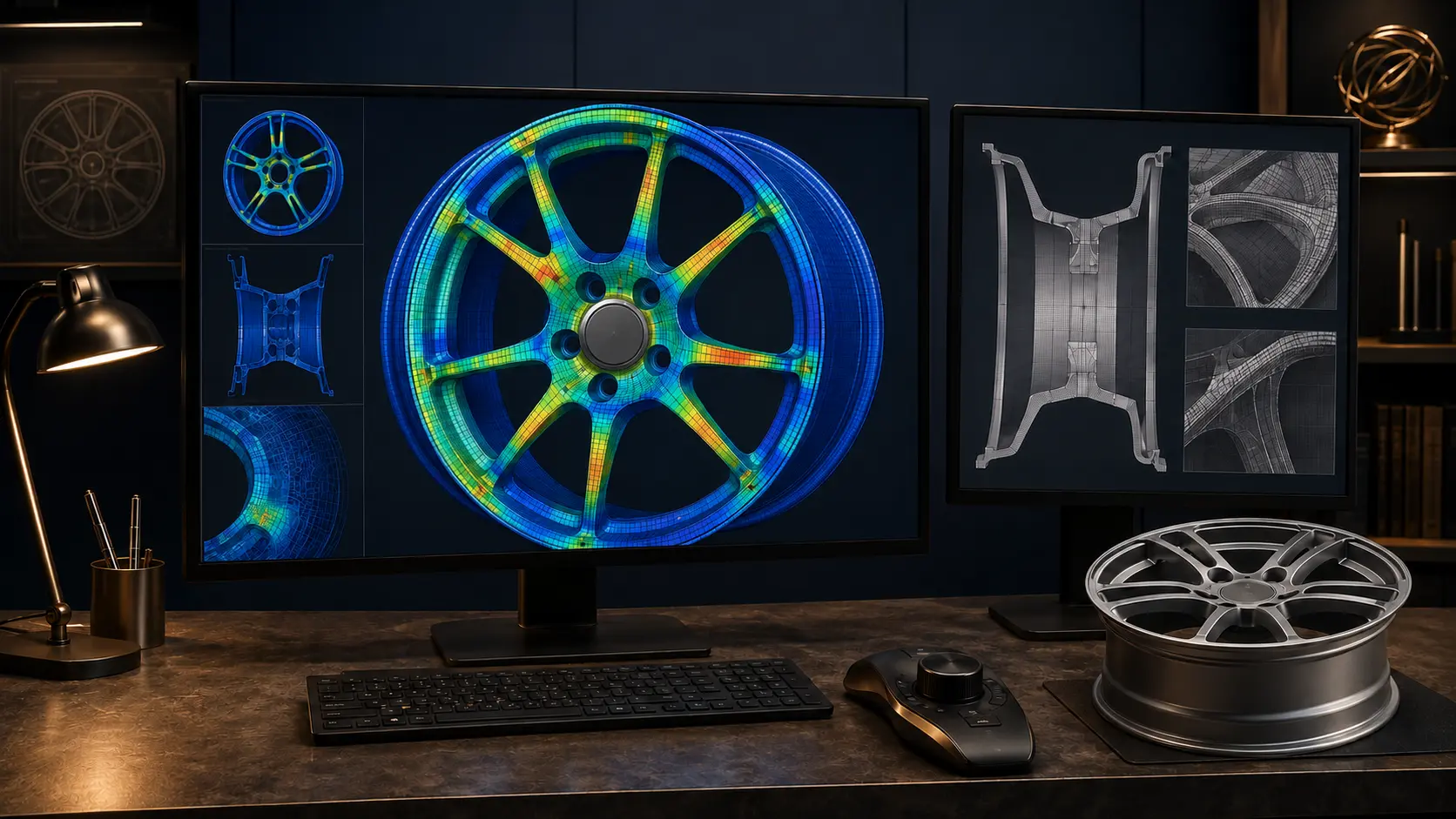 ILLUSTRATIVE EXAMPLE — NO PASS / FAIL RESULT
The nominal wheel diameter at the tyre bead-seat, expressed in inches. It is not the outer edge-to-edge measurement.
The nominal distance between the tyre bead seats. Overall wheel width is greater and must not be substituted for it.
The distance between the wheel centreline and the hub-mounting face. Positive offset places the mounting face toward the wheel's outer side.
The diameter of the circle through the centres of the wheel-bolt or stud holes, stated together with their number, for example 5 × 112.
The centre opening that locates around the vehicle hub. Its diameter and the hub-centric interface must match the specified system.
The maximum load assigned to the exact wheel specification under its documented conditions. It must be adequate for the vehicle and application.
The distance the tyre travels in one revolution under defined conditions. It depends on the actual tyre, not the wheel diameter alone.
Brake, suspension, body, tyre, steering and deflection clearances must be considered together and physically verified where required.
Materials without shortcuts
These explanations establish a useful starting point. They do not replace a material record, drawing, calculation, test or approved order basis.
The word aluminium does not identify one exact wheel material. Alloy, blank, forming route, heat treatment, machining basis and documentation must be defined for the individual project.
Forging and aluminium are not competing terms. A forged wheel starts from a metal blank that has been formed before machining; the exact route and evidence still belong to the project record.
Material, corrosion protection, use, production capability and verification must be established before a magnesium direction can move beyond exploration.
A hybrid concept joins different material systems. Architecture, interfaces, loading, manufacturing control and the required evidence must be defined before it can be treated as buildable.
General care / preliminary
General advice is intentionally conservative. The wheel's own finish, construction, hardware and supplied care instruction decide the final method.
Let the wheel cool, remove loose contamination carefully and avoid making an unverified chemical or abrasive method the first choice.
Painted, polished, anodised, brushed and otherwise treated surfaces may require different care. The supplied finish-specific instruction controls.
Do not leave residues in details or around hardware. Dry with a clean, suitable material and inspect for damage, coating change or loose components.
Damage, corrosion, impact, a coating change or a suspected loose component calls for project-specific assessment rather than stronger cleaning.
We accept a limited number of projects each year.